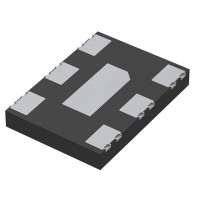
The component specified, the SiTime SIT3372AC-4E2-28NY128.000000, is a high-performance MEMS-based Voltage-Controlled Crystal Oscillator (VCXO) with a 128.0000 MHz output in HCSL (High-Speed Current Steering Logic) format. It belongs to the critical category of timing components, specifically oscillators, which act as the heartbeat or clock signal for synchronous digital systems. Its primary role is to generate a precise and stable frequency reference that can be finely adjusted (via a control voltage) to synchronize with an external source, a process essential in applications like high-speed data communication, network synchronization, and video broadcasting where timing alignment is paramount.
When selecting a VCXO, several key parameters are paramount. Frequency stability, often specified in parts per million (ppm), defines how much the output frequency can deviate due to temperature changes, aging, and supply voltage variations; tighter stability indicates higher performance. Pull range specifies the maximum frequency deviation achievable via the control voltage, which is crucial for synchronization loops. Phase noise and jitter are critical for signal integrity in high-speed serial links, measuring short-term frequency instability. The output logic (HCSL, in this case) must be compatible with the receiving IC, such as an FPGA, ASIC, or serializer/deserializer. Other vital specs include supply voltage, operating temperature range, package size, and reliability metrics like MTBF (Mean Time Between Failures).
Comparing this SiTime MEMS VCXO to traditional quartz-based alternatives reveals distinct trade-offs. In terms of performance, MEMS oscillators like the SIT3372 series typically offer superior resilience to environmental stressors. They exhibit significantly better resistance to shock, vibration, and acceleration, which is a decisive advantage in industrial, automotive, or aerospace applications. They also generally provide faster startup times and better longevity. Quartz VCXOs, however, have historically held an edge in achieving the absolute lowest phase noise for the most demanding RF and test equipment, though high-end MEMS like this SiTime part have closed this gap considerably. On cost, MEMS oscillators have moved from being premium-priced to highly competitive, especially when considering total cost of ownership that includes reduced board-level rework and higher assembly yield. For availability, SiTime's fabless semiconductor model and MEMS-first architecture provide more resilient supply chains compared to quartz, which can be susceptible to shortages of raw crystal blanks and specialized packaging.
Industry trends are strongly favoring MEMS technology in timing. The drive towards miniaturization and higher integration continues, with oscillators moving into smaller packages and offering more programmability. The expansion of 5G infrastructure, cloud data centers, and automotive Ethernet is creating massive demand for robust, high-frequency, low-jitter clocks like this 128 MHz HCSL VCXO. Furthermore, the industry is prioritizing supply chain diversification and resilience, moving away from single-source, geographically concentrated quartz manufacturing. The trend towards in-system programmability allows a single MEMS oscillator SKU to cover multiple frequencies, reducing inventory complexity, a feature available in other SiTime families.
You should choose this specific SiTime SIT3372AC VCXO when your design requires a combination of high frequency, precise synchronization capability, and exceptional mechanical robustness. It is an ideal candidate for timing cards in telecom equipment, network switches, and broadcast video gear where system clocks must be phase-locked to a backplane or network reference. Its HCSL output makes it directly compatible with many high-speed serial interface clocks. Choose this over a basic quartz VCXO if your environment experiences high vibration, wide temperature swings, or if you have experienced field failures due to cracked crystals. It is also a strategic choice for long-lifecycle products where securing a stable, multi-year supply is critical.
From a procurement standpoint, several considerations are vital. Lead times for SiTime MEMS oscillators are typically more stable and predictable than for quartz, but always verify with your distributor for current forecasts, especially in light of ongoing global semiconductor allocation. The lifecycle status of this component is active and supported for new designs; SiTime generally offers long-term availability guarantees, a significant advantage over many quartz products which can be abruptly discontinued. Regarding second-source options, this is a primary consideration. While other MEMS timing companies (e.g., Microchip's timing division) offer VCXOs, a pin-for-pin, spec-for-spec second source for this exact SKU is unlikely due to proprietary MEMS technology. The procurement strategy, therefore, should focus on securing an assured allocation from authorized distributors and potentially qualifying a functionally equivalent alternative (a different VCXO meeting the same electrical specs) as a design backup, rather than a direct drop-in replacement. Building a strong relationship with a franchised distributor who can provide visibility into the silicon supply chain is highly recommended for this category of component.