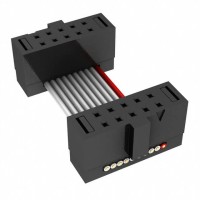
For the Samtec FFSD-05-D-120.0-01-N-RN1, a .050" x .050" centerline female IDC assembly, ensuring reliability and quality requires a comprehensive approach aligned with its application in high-density board-to-board or wire-to-board interconnects. This component's performance is critical to system integrity, making adherence to specific standards and proactive quality measures essential.
Reliability standards and qualifications relevant to this component begin with the manufacturer's internal testing, which should comply with industry norms. For this Samtec part, key standards include EIA-364 (Electrical Connector Test Procedures) for mechanical durability, contact resistance, and insulation resistance. MIL-STD-1344 may be referenced for military or aerospace applications, though commercial standards are typically sufficient. Qualification often involves testing for vibration, mechanical shock, thermal cycling, and humidity exposure per IEC 60512. Crucially, the IDC (Insulation Displacement Contact) termination's reliability is validated through tests that simulate the stress of mating/unmating cycles and long-term contact integrity under load.
Accelerated life testing and what the results mean are vital for predicting long-term performance. For this connector, ALT typically involves elevated temperature-humidity bias testing (e.g., 85°C/85% RH with electrical bias) and thermal cycling far beyond normal operating ranges. These tests accelerate failure mechanisms like contact fretting corrosion, plastic housing degradation, or loss of normal force in the IDC contacts. Results, often presented as cycles or hours to failure, are used to extrapolate lifetime under real-world conditions using models like the Arrhenius equation for temperature or Coffin-Manson for thermal cycling. A successful ALT profile indicates robust design, but results must be interpreted with an understanding of the specific accelerated stresses versus actual use environment.
Failure rate calculations (FIT rates) and MTBF considerations for connectors like this are often derived from industry handbook data, such as Telcordia SR-332 or MIL-HDBK-217F. These models use factors including contact pitch, applied current, environmental temperature, and quality level to predict Failure-In-Time (FIT) rates, where 1 FIT equals one failure per billion device-hours. The calculated MTBF is the inverse of the total failure rate for the assembly. It is critical to remember that these are statistical predictions for a population, not a guarantee for a single unit. For the FFSD series, using the manufacturer's own field return data to adjust these models provides the most accurate reliability prediction for your specific application.
Environmental stress screening and burn-in procedures are generally not applied to passive components like connectors at the unit level, as they are not cost-effective and could induce wear. However, board-level or system-level ESS, incorporating thermal cycling and vibration, can reveal latent defects such as poor crimps or cracked housings. For high-reliability applications, a sample-based burn-in of populated cable assemblies at elevated temperature with electrical monitoring can verify the stability of the IDC terminations under continuous electrical load before deployment.
Counterfeit detection methods specific to this component type must be rigorous given the risk of recycled or substandard connectors. For this Samtec part, start with a visual inspection of packaging, labels, and tape & reel authenticity. Examine the component for authentic Samtec laser marking, including part number, date code, and logo—counterfeits often have blurred or ink-based markings. Use dimensional analysis with optical comparators or microscopes to check critical features like contact pitch, housing geometry, and latch mechanism against the manufacturer's datasheet. Material analysis, such as X-ray Fluorescence (XRF), can verify the specified gold-over-nickel plating on contacts and the correct LCP (Liquid Crystal Polymer) housing material. Electrical testing for contact resistance and dielectric withstanding voltage can also reveal substandard materials or plating.
Incoming inspection best practices should employ AQL sampling per ANSI/ASQ Z1.4. Inspection checks must include: verification of part number and lot code; visual inspection for bent pins, molding flaws, or contamination; dimensional spot-checks of pin alignment and housing features; and mechanical verification of the latch engagement and retention force. For the IDC contacts, a cross-section analysis on a first-article or lot-sample basis can confirm proper conductor crimp and insulation displacement. Electrical testing of sample units for contact resistance (should be in the low milliohm range) and insulation resistance is also recommended.
Storage and handling requirements to maintain reliability are crucial to prevent degradation before use. Samtec connectors should be stored in their original moisture-barrier bags at temperatures below 40°C and relative humidity below 60%. The factory bag's humidity indicator card should be monitored. If removed, these components are sensitive to moisture absorption (MSL rating), which can cause popcorning during reflow if applicable. Always handle using ESD-safe procedures, as the contacts are static-sensitive. Avoid touching the contact surfaces to prevent contamination from oils and salts. Use within the shelf life recommended by the manufacturer, typically two years from date of shipment when stored in unopened bags.
End-of-life management and obsolescence planning is a proactive necessity. For catalog parts like this Samtec series, monitor manufacturer PCNs (Product Change Notices) and PDNs (Product Discontinuance Notices). Establish a last-time buy strategy based on forecasted lifetime needs. Consider identifying and qualifying alternative form-fit-function replacements from Samtec or other reputable manufacturers well in advance. For long-lifecycle products, maintaining a controlled buffer stock under proper storage conditions is the most reliable mitigation. Engage with authorized distributors and the manufacturer directly for obsolescence forecasts and potential lifecycle extension programs.