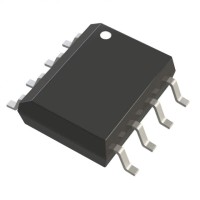
The AD8002ARZ-R7 from Analog Devices is a high-performance, current-feedback amplifier (CFA) offering exceptional speed and bandwidth, making it ideal for demanding applications like video distribution, high-speed signal processing, and RF/IF stages. Unlike voltage-feedback amplifiers, its architecture provides bandwidth largely independent of closed-loop gain, but requires specific design practices to harness its full potential. This application note provides practical guidance for integrating this component into a robust and high-performance circuit.
Recommended circuit topologies and design best practices center on understanding the CFA's unique characteristics. The AD8002 excels in non-inverting configurations, which are generally preferred for stability. While it can be used in inverting topologies, careful attention to the feedback network's impedance is even more critical. The key design rule is to keep the impedance at the inverting input (the feedback node) low and constant. This is achieved by using small resistor values in the feedback network. A typical gain-of-+2 video driver circuit might use Rf = 402Ω and Rg = 402Ω. Avoid using large resistor values or parasitic capacitances at this node, as they introduce a pole that can degrade phase margin and cause peaking or oscillation. Always use the recommended feedback resistor values from the datasheet as a starting point, as these are characterized for optimal performance.
Component selection guidelines for supporting passives are paramount for stability and bandwidth. For the critical feedback and gain-setting resistors, use low-inductance, surface-mount chip resistors with tight tolerances (1% or better). Thin-film types are preferred. The power supply pins must be decoupled with a combination of capacitors placed as close as physically possible to the device pins. Use a 0.1 µF ceramic capacitor (X7R or better) from each supply pin to ground, supplemented by a larger 10 µF tantalum or ceramic capacitor per supply rail nearby for low-frequency decoupling. For applications driving capacitive loads, which can destabilize a CFA, a small isolation resistor (e.g., 10-50Ω) in series with the output is often necessary. Select this resistor based on bench testing to ensure stability without excessively compromising output swing or bandwidth.
PCB layout recommendations and routing tips directly impact high-frequency performance. Use a solid, low-impedance ground plane. Place the AD8002, its feedback resistors, and its supply decoupling capacitors on the same side of the board, minimizing all trace lengths. The feedback path (from output to the inverting input) must be as short and direct as possible to minimize parasitic inductance and capacitance. Route input signals away from outputs and power traces to prevent coupling. If using a split supply, ensure the ground return paths for input, output, and power are not shared in a way that creates ground loops. For the exposed pad (if applicable in your package variant), solder it to a grounded copper pour for improved thermal performance and mechanical stability, but ensure this does not introduce stray capacitance at sensitive nodes.
EMC/EMI considerations and mitigation strategies involve containing the amplifier's high-frequency energy. The low-impedance feedback network and proper decoupling already serve as foundational EMI mitigation. Enclose the circuit within a grounded shield or Faraday cage in noisy environments. Use controlled-impedance routing, especially for input and output traces, and consider placing series termination resistors at the driver output if the trace is long to prevent reflections. Filtering at the input, such as a simple RC low-pass filter with a cutoff just above your signal band, can reject out-of-band RFI that might otherwise be rectified by the amplifier's input stage. Ensure all unused board space is filled with grounded copper to act as a shield.
Common design pitfalls and how to avoid them include neglecting the current-feedback model. First, attempting to use the amplifier as an integrator or in a photodiode transimpedance configuration without careful compensation is risky; CFAs are not naturally suited for high-gain, low-noise integration. Second, using excessively high resistor values in the feedback network is a frequent cause of oscillation—stick to the datasheet's guidance. Third, overlooking the need for output isolation when driving cables or other capacitive loads will lead to instability. Finally, assuming the device will perform identically on a breadboard is a mistake; its high bandwidth makes it sensitive to parasitics, necessitating a proper PCB for validation.
Prototyping tips and bench testing procedures should begin with a well-designed evaluation board or your own carefully laid-out PCB. When powering up, use current-limited supplies. Initial testing should use a low-voltage sine wave (e.g., 10 MHz, 100 mVpp) into the intended load. Observe the output on an oscilloscope with a properly compensated, high-bandwidth probe. Check for overshoot, ringing, or oscillation, which indicate instability. Sweep the frequency to verify bandwidth and pulse response for square waves to check for settling anomalies. Always test with the actual load the circuit will drive in the final application, as load impedance directly impacts stability. Methodically vary supply voltages and input signals to ensure robust operation across the entire expected operating range.