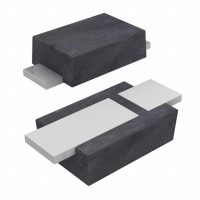
The P4HE13A from Panjit International is a surface-mount transient voltage suppressor (TVS) diode array designed to protect sensitive I/O lines from electrostatic discharge (ESD), electrical fast transients (EFT), and other voltage surges. Its low clamping voltage and fast response time make it ideal for safeguarding high-speed data ports, such as USB, HDMI, Ethernet, and general-purpose microcontroller I/O, in consumer electronics, industrial controls, and communication devices. Successful implementation requires careful attention to circuit integration, layout, and testing.
Recommended circuit topologies and design best practices center on placing the TVS array as close as possible to the connector or point of entry for the signals you intend to protect. For multi-line protection like that offered by the P4HE13A, each protected signal line should be connected to an I/O pin of the device, with the corresponding ground pin connected directly to the system ground plane. The most effective topology is a shunt configuration, where the TVS diverts surge current away from the protected IC and directly to ground. It is critical to ensure a low-impedance path to ground. For bidirectional data lines, the symmetrical clamping characteristic of the diode array is ideal. Always ensure the operating voltage of your signal does not exceed the device's reverse standoff voltage, and consider the typical clamping voltage under expected surge conditions to guarantee it remains below the absolute maximum rating of your protected circuitry.
Component selection guidelines for supporting passives are generally minimal, as the TVS is designed to be used directly on the line. However, in some high-speed applications, a small series resistor (e.g., 0-10 ohms) may be placed between the TVS and the protected IC. This resistor, in conjunction with the TVS's dynamic resistance, can help limit peak current into the IC and can slightly improve ESD performance, but it will also create an RC time constant that may affect signal integrity. The value must be carefully chosen based on signal speed and line impedance. No other passive components are typically required in series with the TVS. Decoupling capacitors for the protected IC should remain on the IC side of the TVS device to ensure a clean local supply.
PCB layout recommendations and routing tips are paramount for the TVS to function effectively. The single most important rule is to minimize the inductance of the path from the TVS to the connector and from the TVS ground pin to the system ground plane. Use short, direct, and wide traces—especially for the ground connection. The TVS ground pin should be connected to the system ground plane via multiple vias directly at the pad. Avoid sharing this ground connection with other components; create a dedicated, low-impedance sink for surge currents. The protected signal trace should run from the connector pin directly to the TVS pad before continuing on to the internal circuitry. Do not place the TVS "off to the side" of the main trace with a stub, as the inductance of the stub will degrade performance.
EMC/EMI considerations and mitigation strategies involve the TVS's role in both immunity and emissions. For immunity (ESD, EFT, Surge), the proper layout described above ensures fast, effective clamping, preventing system resets or latch-up. For controlling electromagnetic emissions, the rapid switching of the TVS during a clamping event can itself generate high-frequency noise. To mitigate this, ensure the TVS's ground path is impeccably low-inductance to provide a tight loop area for the surge current. In very noise-sensitive designs, a ferrite bead can be placed on the trace between the TVS and the internal circuitry to filter high-frequency noise generated during clamping, but this must be evaluated for signal integrity impact. The TVS should be seen as part of a holistic EMC strategy that includes proper grounding, shielding, and filtering.
Common design pitfalls and how to avoid them include: First, placing the TVS too far from the connector, which adds trace inductance that increases the voltage seen by the protected IC before the TVS activates. Always place it adjacent to the entry point. Second, using a long, thin trace or a single via for the TVS ground connection, which creates high impedance and renders the TVS ineffective. Use a solid ground pour and multiple vias. Third, forgetting to consider the TVS's parasitic capacitance on high-speed lines, which can cause signal attenuation and distortion. Verify the P4HE13A's capacitance is compatible with your data rate (e.g., USB 2.0 is generally fine; for higher speeds, check specifications carefully). Fourth, assuming the TVS protects against overvoltage from the power supply; it is designed for short-duration transients on signal lines, not sustained overvoltage.
Prototyping tips and bench testing procedures should begin with a visual inspection of the PCB layout against the critical placement and routing rules. For functional testing, use a variable power supply to verify the TVS does not leak or conduct at the normal operating voltage of your circuit. For surge immunity testing, an ESD simulator (gun) is used to apply test pulses (e.g., IEC 61000-4-2) directly to the connector pins while monitoring system functionality. Use a current probe and a high-bandwidth oscilloscope to observe the clamping response on the protected line; the voltage spike should be suppressed to a level below your IC's maximum rating. Compare performance between a board with optimal layout and one with intentional flaws (like a long ground stub) to empirically validate the importance of layout. Always test under real-world operating conditions with the full system powered.