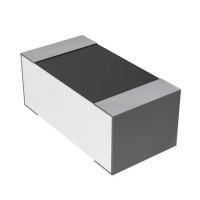
The TE Connectivity 33.2kΩ, 0.1%, 1/16W 0603 resistor (4-2176089-6) is a precision surface-mount component designed for applications demanding high accuracy and stability. Its tight tolerance and compact size make it suitable for critical signal conditioning, voltage division, feedback networks, and sensor biasing circuits where minor resistance variations can significantly impact system performance. When integrating this component, careful consideration of the circuit environment, layout, and supporting parts is essential to realize its full precision potential.
Recommended circuit topologies and design best practices center on leveraging the 0.1% tolerance for accuracy-critical nodes. Prime applications include the gain-setting and feedback networks of precision operational amplifiers, voltage references, and analog-to-digital converter (ADC) input scaling dividers. In a voltage divider for a reference voltage, using two resistors from the same batch (like this 33.2kΩ part) minimizes ratio errors due to tracking over temperature. For current sensing, while this part's low absolute tolerance is beneficial, its 1/16W power rating limits its use to very low-current signals; always calculate power dissipation (P=I²R) to ensure it remains well below 62.5mW, preferably below 30mW for reliable long-term operation. In filter circuits, its tight tolerance helps maintain precise cutoff frequencies. A key best practice is to always consider the temperature coefficient (TCR), which for this component is typically 25 ppm/°C. Even with 0.1% initial accuracy, thermal gradients on the PCB can introduce errors larger than the initial tolerance if the resistor's self-heating or ambient shifts are not accounted for in error budget analysis.
Component selection guidelines for supporting passives must follow a "similar pedigree" philosophy. Pair this resistor with other high-stability components to avoid undermining its precision. In a voltage divider, the matching resistor should have an identical tolerance, TCR, and package size to ensure tracking. The operational amplifier or ADC it interfaces with should have sufficient offset voltage and bias current specifications so that resistor-induced errors remain the dominant concern. For bypassing, use stable, low-ESR ceramic capacitors (e.g., C0G/NP0 dielectric for critical analog nodes) near the ICs powered through or referenced by this resistor. If used in an RC timing circuit, select a capacitor with a similarly tight tolerance and low dielectric absorption to maintain timing accuracy.
PCB layout recommendations and routing tips are crucial for preserving signal integrity and minimizing parasitic effects. Place the resistor as close as possible to the active device (op-amp, ADC, etc.) it is associated with to minimize trace length and reduce parasitic capacitance and pickup. For sensitive analog signals, route connections away from noisy digital traces or switching power lines. If the resistor is part of a matched pair (like in a divider), use a symmetrical, common-centroid layout if possible, and ensure both resistors are on the same copper plane and experience identical thermal environments. Use generous teardrops at pad connections to improve manufacturability and reduce stress. The 0603 package requires a standard footprint; ensure your solder paste stencil aperture is correctly sized to prevent tombstoning. For the most critical applications, consider guarding sensitive high-impedance nodes connected to this resistor with a ground trace to minimize leakage currents.
EMC/EMI considerations and mitigation strategies involve treating the resistor as part of a potential antenna or victim circuit. While a resistor itself is not a primary emitter, the traces connecting it can be. Keep high-impedance nodes (like the input of an op-amp connected to this resistor) as physically small as possible to reduce capacitive pickup of external noise. If the resistor is in a feedback loop, minimizing the loop area formed by the resistor, the op-amp output, and the inverting input is vital for reducing magnetic pickup and high-frequency instability. In some cases, a small parasitic capacitor (a few pF) placed in parallel with a feedback resistor can help mitigate EMI-induced rectification, but this will affect frequency response. Always follow solid ground plane practices, ensuring a continuous return path beneath the signal traces associated with the precision resistor.
Common design pitfalls and how to avoid them often relate to overlooking secondary specifications. First, ignoring power derating: operating at the full 1/16W rating will cause significant self-heating, shifting the resistance value via TCR and potentially impacting long-term reliability. Always derate power. Second, assuming tolerance is the only error source: the initial tolerance, TCR, soldering shifts, and long-term drift all contribute to the in-circuit error. Calculate a worst-case error budget. Third, poor thermal management: placing a precision resistor near a power IC or on a different thermal plane than its matched partner introduces thermally-induced errors. Fourth, using inappropriate solder paste or reflow profiles that can stress the component, altering its value. Consult the manufacturer's handling guidelines.
Prototyping tips and bench testing procedures should validate both the static and dynamic performance. When prototyping, use a PCB that mirrors the intended final layout as closely as possible; hand-wired breadboards introduce parasitic capacitances and thermal issues that nullify the benefits of a 0.1% resistor. For testing, use a high-impedance, accurate digital multimeter to verify the installed resistance value, but be aware that the meter's test voltage may be insufficient to reveal soldering faults. Power the circuit and measure the voltage across the resistor to verify its in-circuit function and calculate actual power dissipation. Use a temperature probe to monitor the resistor's body temperature during operation to assess self-heating effects. For dynamic applications, use an oscilloscope to check for noise or instability on the node, ensuring bandwidth limitations of the circuit are as designed. Finally, perform a basic thermal stress test by applying circuit power and using controlled hot/cold air to observe resistance node stability over a reasonable temperature range, ensuring the system performance meets specifications under expected operating conditions.