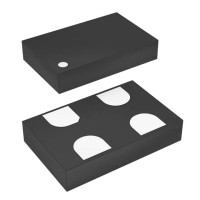
Today we're designing a practical clock generation circuit using the SiTime SIT1602BI-32-XXE-7.372800 MEMS oscillator. This component is an excellent tutorial subject because it represents the modern shift from traditional quartz crystals to Micro-Electro-Mechanical Systems (MEMS) timing. Unlike a crystal, which requires an external amplifier circuit (like in a Pierce oscillator configuration), this device is a complete oscillator in a single package. It outputs a ready-to-use 7.3728 MHz CMOS-level square wave, a common frequency for UART communication (allowing for standard baud rates like 115200). Its "H/LV-CMOS" designation means it can operate across a wide voltage range, typically 1.8V to 3.3V, making it versatile for mixed-voltage system design.
Our design requirements are to create a stable, low-noise 7.3728MHz clock source for a 3.3V microcontroller. Key specifications we must meet include a 3.3V ±10% supply, a maximum frequency stability of ±25ppm (as per the SiTime datasheet), and an output capable of driving a single CMOS load with minimal jitter. We'll also design for decoupling to ensure power integrity and include optional footprints for additional filtering. The goal is a robust, production-ready circuit block that can be dropped into a larger design.
The step-by-step design process is refreshingly straightforward, which is a major advantage of using a fully integrated oscillator. The primary task is power supply conditioning. The datasheet specifies a 100mA maximum current consumption. We'll calculate our decoupling capacitor values based on transient current demands. A good starting point is a two-stage decoupling approach: a bulk capacitor (like 10µF) to handle lower-frequency surges and a smaller, low-ESL ceramic capacitor (0.1µF) placed extremely close to the device's VDD pin to handle high-frequency noise. The enable pin (OE) can be tied directly to VDD if always-on operation is desired, or connected to a microcontroller GPIO for power management. No external resistors or capacitors are needed to set the frequency—it's factory-programmed.
The component selection rationale for our Bill of Materials (BOM) hinges on reliability and noise suppression. The core component is, of course, the SiTime SIT1602BI-32-XXE-7.372800. For decoupling, we select a 10µF, 6.3V, X5R ceramic capacitor (C_BULK) and a 100nF, 10V, X7R 0402 ceramic capacitor (C_DECOUPLE). X7R/X5R dielectrics are chosen for their stability with voltage and temperature. The small 0402 footprint for C_DECOUPLE minimizes parasitic inductance. If we anticipate noisy power rails, we can add an optional ferrite bead (e.g., 600Ω @ 100MHz) in series with VDD and a second 100nF cap on the oscillator side to form a pi-filter. A 10kΩ pull-up resistor for the OE pin is wise if it's driven by an open-drain signal or might be left floating during MCU reset. The output should connect directly to the load; a small series resistor (22-33Ω) can be optionally added to the clock line to reduce ringing if trace length is significant.
For simulation tips, focus on power integrity and signal quality. While simulating the oscillator itself requires a proprietary model, you can create a behavioral voltage-controlled pulse source set to 7.3728MHz. The critical simulation is a transient analysis of the power rail at the oscillator's VDD pin. Inject a simulated current step (modeling the oscillator's internal switching) and verify the voltage ripple remains within the datasheet's noise tolerance (typically ±50mV). Also, run an AC analysis to confirm your decoupling network provides a low-impedance path to ground across a broad frequency range. When examining the output clock in simulation, look for clean, sharp edges with minimal overshoot or ringing, which would indicate impedance mismatch.
The prototype build and testing methodology should be meticulous. First, assemble the minimal circuit on a breadboard or, preferably, a dedicated breakout PCB, as breadboards introduce significant parasitic capacitance and noise. Use short, direct traces, especially for the decoupling capacitor. For testing, power up the circuit and immediately check for excessive current draw. Then, using an oscilloscope with a properly grounded probe tip, measure the VDD pin to verify it is a clean 3.3V. Next, probe the clock output. Always use the oscilloscope's bandwidth limit function (e.g., 20MHz) when measuring frequency and amplitude to filter out high-frequency noise and get a stable reading. Check the waveform for correct logic high and low voltages, duty cycle (typically 45%-55%), and rise/fall times.
Performance verification and optimization involve quantifying key parameters. Measure the frequency with a frequency counter or your scope's measurement function; it should be within the stated ±25ppm tolerance. To check for jitter, use your oscilloscope's cycle-to-cycle or period jitter measurement function over thousands of cycles. If jitter is higher than expected or you see noise on the clock edges, optimize your decoupling. You can experiment with adding the optional ferrite bead filter or slightly increasing the bulk capacitance. Ensure the ground path is solid; a poor ground is often the source of noise. Finally, perform a rudimentary temperature stability test by applying gentle heat (from a hair dryer) or cold (compressed air duster held upside down) to the oscillator while monitoring frequency drift. A well-designed circuit with this SiTime MEMS oscillator will exhibit robust performance with minimal tweaking, validating the simplicity and reliability of modern MEMS timing solutions.