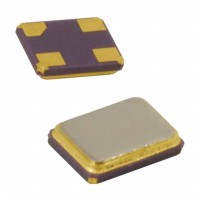
Interpreting the datasheet for a quartz crystal, such as the NDK America NX2520SA-26MHZ-STD-CSX-1, is fundamental to ensuring stable and reliable oscillator performance in your design. This component is a 26.0000 MHz fundamental mode, 8 pF load crystal resonator in a compact 2.5mm x 2.0mm SMD package. The core specification is its load capacitance (CL) of 8 pF. This is not the internal capacitance of the crystal but the external capacitive load the crystal is designed to operate with across its terminals. In practice, the oscillator circuit in your microcontroller or dedicated oscillator IC must be configured to present this exact capacitive load to the crystal for it to oscillate at the specified frequency. Deviation from this load will cause a frequency pull, shifting the clock away from 26.0000 MHz, which is critical for timing-sensitive applications like USB or Ethernet.
Other key electrical parameters include the frequency tolerance and frequency stability. Tolerance specifies the initial frequency deviation at room temperature (typically ±10 to ±30 ppm for a standard part), while stability defines how much the frequency can drift across the operating temperature range (e.g., -20°C to +70°C). The equivalent series resistance (ESR) is crucial; it represents the crystal's motional resistance in series resonance. A lower ESR, typically in the range of 40 to 80 ohms for a 26 MHz crystal in this package, makes the crystal easier to start and sustain oscillation. Exceeding the drive level specification, which is the maximum power dissipation allowed in the crystal (often in the microwatt range), can lead to accelerated aging, frequency shifts, or even physical damage. The oscillator circuit must be designed to limit current to stay below this rating.
Absolute maximum ratings are guardrails to prevent immediate destruction. For this crystal, these include the storage temperature range and the maximum drive level. It is critical to note that these are not operating specifications. Derating is a key practice, particularly for reliability in harsh environments. While the operating temperature range might be specified, designing for a range 10-15°C inside those limits improves long-term stability. Similarly, operating the crystal at 50-70% of its maximum drive level rating enhances longevity and minimizes aging effects. Mechanical shock and vibration ratings are also provided; if your application is subject to such stresses, ensuring the PCB layout provides robust mechanical support and considering underfill for the crystal package are prudent derating measures.
The typical application circuit is a Pierce oscillator, the most common configuration for parallel resonant crystals like this 8 pF load type. The crystal connects between the input and output of an inverting amplifier inside the oscillator IC. Two external capacitors, C1 and C2, are placed from each crystal pin to ground. These, along with the PCB stray capacitance and the IC's internal pin capacitance, combine to form the total load capacitance. The formula CL = (C1 * C2) / (C1 + C2) + Cstray approximates the effective load. For a target CL of 8 pF, with typical stray capacitance of 2-5 pF, C1 and C2 are often chosen to be in the 10-22 pF range. A high-value resistor (1-10 MΩ) may be placed across the crystal to provide DC bias for the inverter. Some designs include a series resistor to limit drive level.
This component utilizes a four-pad SMD package (2.5mm x 2.0mm). The pin configuration is typically such that the two electrical connections are on the longer sides of the package, with the remaining two pads being mechanical grounds or non-connected. The datasheet will specify which pads are active. Proper PCB layout is paramount. The crystal must be placed as close as possible to the oscillator IC pins, with trace lengths minimized and kept identical in length. The loop area formed by the crystal traces and the load capacitors should be as small as possible to reduce EMI susceptibility and emission. The ground plane should be kept away from the immediate area beneath the crystal body to avoid parasitic capacitance that would affect the load, but a solid ground should surround the circuit. The mechanical ground pads on the crystal should be connected to the PCB ground plane via several vias to enhance mechanical stability and heat dissipation.
While crystals are not significant heat sources, thermal management is still a consideration for frequency stability. The crystal's frequency-temperature characteristic follows a parabolic curve specific to the crystal cut. Placing the crystal away from obvious heat sources like voltage regulators, power amplifiers, or high-current drivers minimizes temperature-induced frequency drift. If the application environment has large thermal swings, selecting a crystal with a tighter stability specification or a different cut (like AT-cut) may be necessary. The PCB's thermal mass and layout can help buffer the crystal from rapid temperature changes.
Datasheets for crystals often include characteristic curves rather than complex timing diagrams. The most critical is the frequency vs. temperature curve. This parabola shows the frequency deviation across the operating range, with the turnover temperature (peak of the parabola) typically at room temperature or slightly above. Interpreting this curve allows you to anticipate the worst-case frequency error in your product's environment. Another common curve plots equivalent series resistance (ESR) versus frequency. This shows that ESR is at a minimum at the series resonant frequency (Fs) and increases as you move away. Since parallel resonant crystals operate between Fs and the parallel resonant frequency (Fp), the ESR at your load frequency is a key parameter for oscillator design margin. A third important graph may illustrate drive level dependence, showing how frequency can shift with applied power. Keeping drive level in the flat, stable region of this curve is essential for consistent performance.